
Opinion: dreams deferred at the border
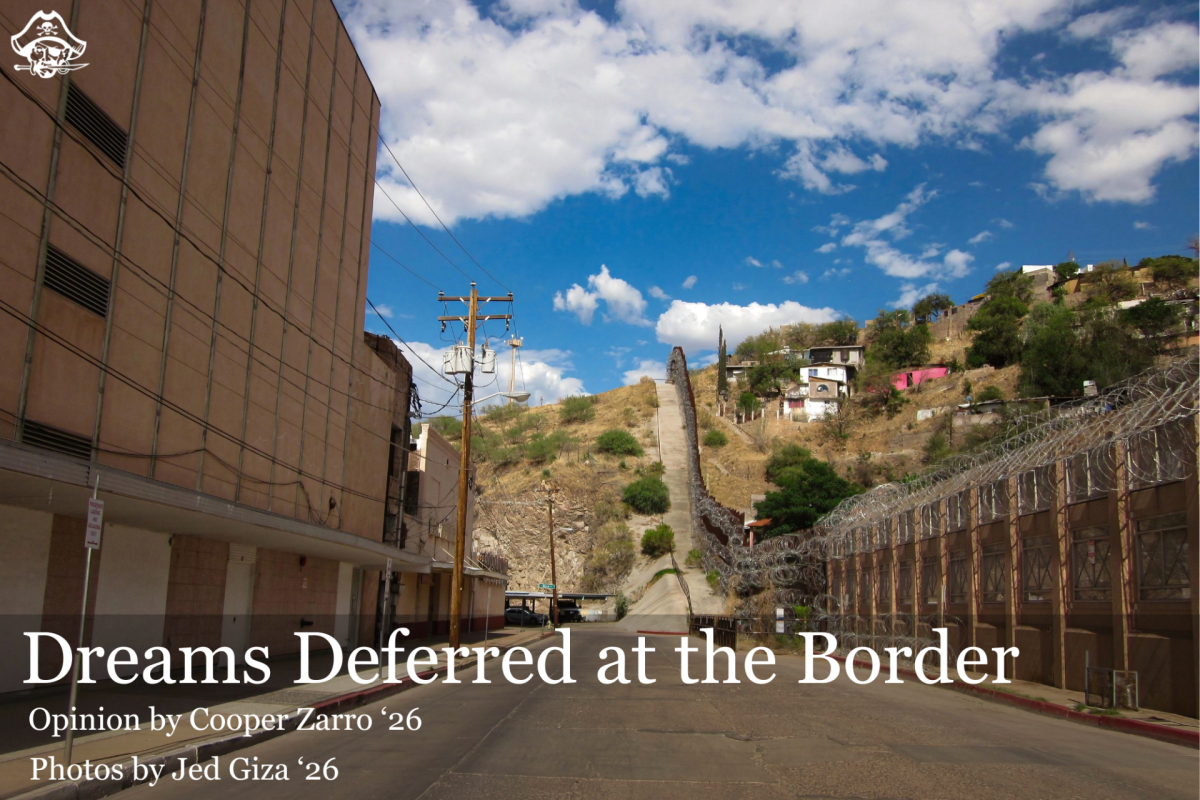
“How many more people have to die in the desert before we find a solution to this problem?”
This summer, I was lucky enough to join seven other Jesuit High School Sacramento students on an immersion trip to the Kino Border Initiative. Straddling the border between the United States and Mexico, in the town of Ambos Nogales, the organization provides essential services to asylum seekers and recently deported migrants: meals, shelter, basic medical care, childcare, and legal assistance.
What I saw there was a failed system. More specifically, an immigration system that has comprehensively failed migrants for the last 30 years. This is not a partisan issue – the problem has only gotten worse with consecutive administrations, both Democrat and Republican. The system has broken down for so many people – like the many I talked to at Kino – in a way that creates a humanitarian crisis at the border. Something needs to be done.
But the smoke of partisan rhetoric and political zealotry clouds all discussion about this issue. Human suffering is obscured by flippant remarks and charged soundbites. How can we work for lasting policy solutions when most of us have no idea what is actually happening at our southern border?
That’s why I wanted to share some of my experience at Kino, in addition to more statistical analysis. Because without a clearer understanding of the issue itself – including its root causes, symptoms, and who it affects – permanent solutions will forever be out of reach.
————————————————————————————————————————————–
One thing that needs to be cleared up, before going further into the issue, is what exactly the “system” is. Plenty of allusions are made to it and its “brokenness”, but if you don’t understand how it works, you cannot diagnose its issues.
There are four main ways to enter the United States legally: temporary visas for areas like work, study, and travel; family reunification; permanent work visas for skilled laborers (such as the hot-button H-1B program); and finally by seeking asylum. Each of these is an incredibly complicated process, replete with individual flaws that contribute to the rot of the American immigration system. Specifically for those entering via the southern border, these pathways are just not feasible for migrants.
To start, the temporary visas are just that: temporary. Obviously this makes sense for student or travel visas, but for many types of work visas, there is no pathway to a permanent residency (a green card), which then leads to citizenship. For a migrant that is fleeing violence or persecution in their country, they cannot come to the United States temporarily, because they simply cannot return to their home country. They need stability, and cannot afford to be uprooted after a certain amount of time.
As for family reunification, there is a pathway to citizenship – it’s just prohibitively long. Depending on the type of reunification visa (for example, spousal, filial, sibling, etc.), the federal government may take as long as 15 years to grant a green card. During this purgatory period, the prospective resident will have to return to their home country to renew a cumbersome amount of paperwork. Even if a migrant has family in the United States – which is certainly not a guarantee – this is not tenable for a migrant fleeing unstable conditions, simply because of how long and drawn out the process is.
Permanent work visas are contingent on two factors: 1.) a sponsoring employer in the United States, and 2.) a skill in some sought after profession. This is again unfeasible for many migrants: though many want to work in the United States, they oftentimes lack formal education, and therefore are classed as “unskilled”. And even for those that do have professional training, they often lack the ability to connect with employers to sponsor them for one of these visas.
Finally we arrive at the pathway that is supposed to be for many of those arriving at the southern border: asylum. Asylum protects migrants that have a history of persecution or well-founded fear of persecution, based on race, religion, nationality, political opinion, or membership in a particular social group. Regardless of the Trump administration’s current freeze on asylum at the southern border, the pre-existing asylum process for entry into the United States has been fraught with issues.
For one, it can be hard for migrants to establish a history of persecution or fear of persecution. For example, queer asylum seekers often have a difficult time proving their identity to qualify for asylum. Secondly, even if you did meet all the qualifications, asylum is considered discretionary, which means that your case could still be denied. According to the Transactional Records Access Clearinghouse, in 2024 only 35.8% of asylum seekers who went before a judge were granted asylum. On top of all these issues, the backlog of asylum cases has been and still is excruciatingly long in the United States.
And so, with no other option, people decide to make the life-threatening trek through the desert.
According to the nonprofit USAFacts, over 8,000 migrants have died attempting the crossing into the United States since 1998. Because of the treacherous conditions created by the U.S. government’s policy of “Prevention through Deterrence” – that has been in effect since the Clinton administration – many migrants are pushed further and further into the desert, where they are more likely to die due to the elements.
But even if the migrants are able to complete their journeys through the elements – whether that’s at the border itself or coming up through the jungles of Central America – their problems do not disappear. In fact, they face legal limbo, trapped in unfamiliar surroundings with no idea where to go next.
————————————————————————————————————————————–
Graciella and her 10-year-old son Aaron were two of the migrants I met and spoke with during my time at Kino. On the second to last day of our trip, Graciella spoke to us at a workshop hosted by the embroidery program at Kino, and recounted her journey to the United States.
Threatened by gang violence, Graciella and Aaron made the decision to flee their home country of Guatemala and make the perilous journey to the United States. On the over 1000 miles they traveled, they faced extortion and violence from “coyotes” (cartel guides) and corrupt cops as well as the perils of traveling through the wilderness. Once they made it to the border, they applied for asylum through the Biden administration’s process – called the CBP One app – and had a hearing set to discern the validity of their asylum claim.
However, this hearing was scheduled for after January 20th, 2025: the day President Trump was inaugurated. Included in the mountain of executive orders he signed into law that day was an elimination of the CBP One app, which left Graciella, Aaron, and thousands of other migrants with no other options stranded in Mexico – alone, in a foreign country, with no prospects for the future.
The CBP One app was used by the Biden administration as a way to streamline asylum claims. Instead of having to come onto United States soil to then declare asylum, migrants could download the app and schedule an appointment at a port of entry that would determine if they met the qualifications for asylum. If the appointment determined that the migrant did indeed meet the qualifications for asylum, they would then be let into the United States, on the condition that they come to court for their asylum hearing. Finally, this hearing would then assess if the migrants could then officially possess asylum status.
Most of the controversy around the CBP One app centered around the period between the appointment and the asylum hearing. Many conservatives believed that migrants would not return for their court date, and remain in the United States “illegally” indefinitely. The alternative to this policy is “Remain in Mexico” where migrants have to stay in Mexico for the long months before their hearing. Safety is a huge concern for the migrants forced to stay in Mexico, as they can face extortion and violence from the very gangs they were fleeing in the first place.
The CBP One app was certainly not perfect. Many migrants were unable to access the app’s resources for a variety of reasons, such as limited language options, a complex interface, and technical glitches. Additionally, there was a huge imbalance in the supply of available appointments compared to the demand, leading to long wait times for migrants that needed these asylum appointments.
But though it was flawed, it was still a system. For a limited number of migrants, the opportunity to claim asylum was upheld, and they could enter the United States to begin the long process of fulfilling their American Dream.
That dream is something that’s seemingly been denied for the migrants at KBI.
During our week there, we spent mealtimes working in the comedor – cafeteria – and speaking with migrants about their experiences. Another migrant I spoke with was a man named Diego. Threatened by gang extortion in his home city of Quito, he was forced to flee Ecuador in the hopes of rejoining his son, who lives in Kentucky.
Through the CBP app, he was able to make an appointment to review his asylum case. But just like Graciella and Aaron, the Trump administration cancelled Diego’s appointment, leaving him alone in an unfamiliar country, forcing him to watch his son grow up from the sidelines.
One of the most interesting parts of Diego’s story is his profession. When he lived in Ecuador, he worked as an engineer – a very skilled position that is in high demand in the United States. According to Bloomberg, the U.S. is unable to fill over a third of the 400,000 engineers we need each year.
Diego’s expertise likely could have helped fill this shortage. But because of the bureaucracy and hyper-selectivity of the immigration process, he’s unable to come and contribute to the United States. Are we harming our nation’s future with a small-minded immigration system?
Diego’s existence also runs counter to the stereotypes we are so often exposed to about migrants. The prevailing narrative about asylum seekers at the southern border is that they are uneducated and unskilled, who serve as a pathway for bringing drugs, violence, and anarchy into the United States. Like always, the truth is much more complicated than the caricature.
The fentanyl crisis is an urgent and pressing problem in the United States – even one overdose is too many, and we have to work to stop this issue. When many Americans picture how these drugs are entering the United States, they see images of cartel “mules” sneaking in with backpacks loaded with fentanyl.
But in reality, the majority of fentanyl coming into the United States is not smuggled in through individuals crossing the border outside legal ports of entry. According to a Department of Homeland Security fact sheet from 2023, over 90% of illicit fentanyl coming into the country is intercepted at ports of entry. The cartels need scale for their operation. The scale that migrants with backpacks that have to travel thousands of miles on foot can provide pales in comparison to the scale offered by truckloads sent through ports of entry.
————————————————————————————————————————————–
People will always want to come to the United States. No matter how many walls are built, no matter how many border patrol agents are on staff, and no matter how much funding is thrown at the problem, migrants that have no other option will find their way in. We’ve seen that through the last quarter century of “Prevention through Deterrence.” Each successive administration since President Clinton – Democrats and Republicans – has thrown more money to border security measures, in the hopes that more deterrents will prevent illegal immigration.
In practice, though, this simply hasn’t worked – the policy has ended with billions of dollars wasted and thousands of migrants dead, and millions more trapped in limbo.
And so, we have to ask ourselves, when we increase funding for deterrence policies like ICE raids, who are we targeting? Is it dangerous criminals and drug dealers, or is it people like Romeo, an undocumented migrant from Guatemala who had lived for 33 years in San Bernardino, with his six children? Because of his deportation, he won’t be able to see his daughter walk the stage at graduation. Who benefits from this?
I am not a policymaker, nor should my words be taken as gospel when it comes to this issue. I merely spent a week observing the challenges that asylum seekers face at our southern border. What I can say with confidence is that any solution to this problem has to do right by the migrants who need the safety and security that are required for life.
Solutions that would do so include increased funding and recruiting for the judiciary system – for faster processing of asylum cases – increasing the cap on legal migration, creating pathways to citizenship for undocumented migrants and DACA recipients, among so many other solutions.
The stories of Graciella, Aaron, Diego, Romeo, and millions of others do not need to end in tragedy, and they should not end in tragedy.